You’ve cleaned up your eating. Your plate is colourful, your meals are built around whole foods, and honestly, you feel pretty good; lighter, more energised, more in tune with your body. So why does your hair seem thinner? Why does it feel weaker, or just… not quite like it used to?
It’s a frustrating thing to notice, especially when you feel like you’re doing everything right. And you’re not alone in experiencing it.
Here’s the thing: hair health isn’t just about what lands on your plate. It’s about what your body can actually do with it. Even the most thoughtfully put-together diet can leave hair follicles quietly missing what they need.
So let’s get into it.
Hair Growth Starts Long Before You See It
Every strand of hair you see started its journey beneath your scalp, inside tiny, incredibly busy follicles that are constantly working to produce new growth. These follicles depend on keratin, the structural protein that gives hair its strength, its bounce, its resilience.
But here’s where it gets interesting: keratin doesn’t come straight from food.
Before your body can use any of the protein you eat, it has to break it down during digestion into amino acids; The small building blocks that your body then reassembles into hair, skin, and nails. Only once that process has happened can those nutrients make their way through your bloodstream and actually reach your follicles.
When everything’s working well, hair grows normally. When something’s off, even slightly, hair is often one of the first places you’ll notice it.
Can Plant-Based Eating Affect Your Hair?
A plant-based diet can be genuinely nourishing. This isn’t about demonising the way you eat. But plant-forward diets do sometimes ask a little more of you when it comes to protein balance.
Plenty of plants contain protein, but some of the amino acids that hair specifically needs can be present in smaller amounts. If your meals aren’t varied enough, or if your digestion isn’t quite firing on all cylinders, your follicles might quietly be running on less than they need.
This isn’t about plant-based eating causing hair loss. It’s about how much protein balance and absorption actually matter. Which brings us to something worth understanding properly.
The “Protein Gap”
The protein gap is simply the difference between the protein you eat and the amino acids your body actually absorbs and puts to use.
Digestion starts in your stomach and continues in your small intestine, where enzymes work to break protein down into usable components. If those amino acids aren’t available in the right balance or aren’t being absorbed efficiently, your hair follicles end up with fewer resources to build strong strands from.
Put simply: eating enough protein doesn’t automatically mean your hair is getting what it needs.
From Plate to Hair Strand: What’s Happening Inside
The journey from food to follicle is more involved than it might seem. Here’s how it works:
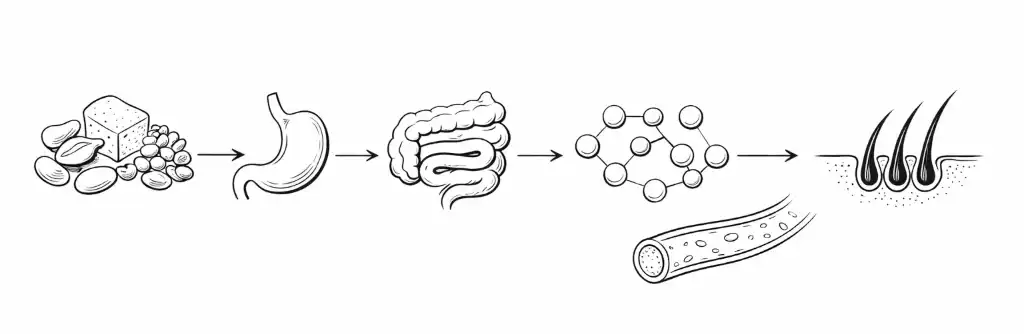
You eat protein → it’s digested in your stomach → broken down further in your small intestine → absorbed as amino acids → carried through your bloodstream → used to build keratin.
Some amino acids play a particularly important role in this process. Cysteine and methionine contribute to hair’s strength, while glycine and proline support its structure and flexibility. Together, they form the quiet architecture behind every strand.
Why Hair Is So Sensitive to What’s Going On Inside You
Hair follicles are remarkably active, but they’re not vital for survival. And your body knows that.
When your body senses any kind of stress, whether that’s nutritional, physical, or metabolic, it starts prioritising. The brain, the heart, your organs, cellular repair, these all come first. Hair growth gets bumped down the list.
That’s why thinning or shedding can sometimes be one of the earliest signals that something internal needs a little more attention. Your body isn’t failing you; it’s just telling you something.
Quality over quantity: the Source of Your Protein Matters
Not all protein behaves the same way once it’s inside your body.
Animal proteins naturally carry a complete amino acid profile. Plant proteins often work better in combination with one another.
Pairing things like legumes with grains, or mixing in a range of nuts, seeds, and diverse whole plant sources, helps build out a broader amino acid spectrum that better supports keratin production. It’s less about eating more and more about eating with a bit more intention.
Subtle Signs Your Hair Might Be Asking for More Support
Hair changes rarely show up all at once. They tend to creep in gradually, easy to brush off at first.
You might notice:
- more shedding than feels normal
- less volume or density overall
- slower regrowth
- strands that feel finer than they used to
- changes in texture or strength
These aren’t just cosmetic concerns. They can be your body’s quiet way of flagging that something has shifted nutritionally.
Looking Closer: The Role of Scalp Analysis
Sometimes, the most useful information comes from actually looking at the scalp directly.
Professional scalp analysis lets specialists examine your follicles under magnification; assessing density, growth patterns, hair thickness, and the condition of the scalp itself. It can reveal how internal factors like nutrition, stress, and metabolism are showing up at the follicle level.
Rather than guessing, it offers something more grounded: a real look at what’s actually going on.
If you’re noticing changes in your hair and want a clearer understanding of what may be influencing it, a more detailed look at your body’s internal balance can be a helpful next step.
The Cell Wellbeing Test offers a personalized insight into nutritional imbalances, sensitivities, and areas your body may need additional support, helping to connect what you’re experiencing externally with what’s happening internally.
Available as an at-home kit or in-clinic assessment, it provides a tailored report designed to support more informed, individualized decisions around your hair and overall well-being.
You can learn more about the test by going to the Clinical Services page.